Fluid Mechanics
Boundary layers
Lecturer: Jacob Andersen
Slides by Jakob Hærvig (AAU ENERGY) and Jacob Andersen (AAU BUILD)
Boundary Layer Structure
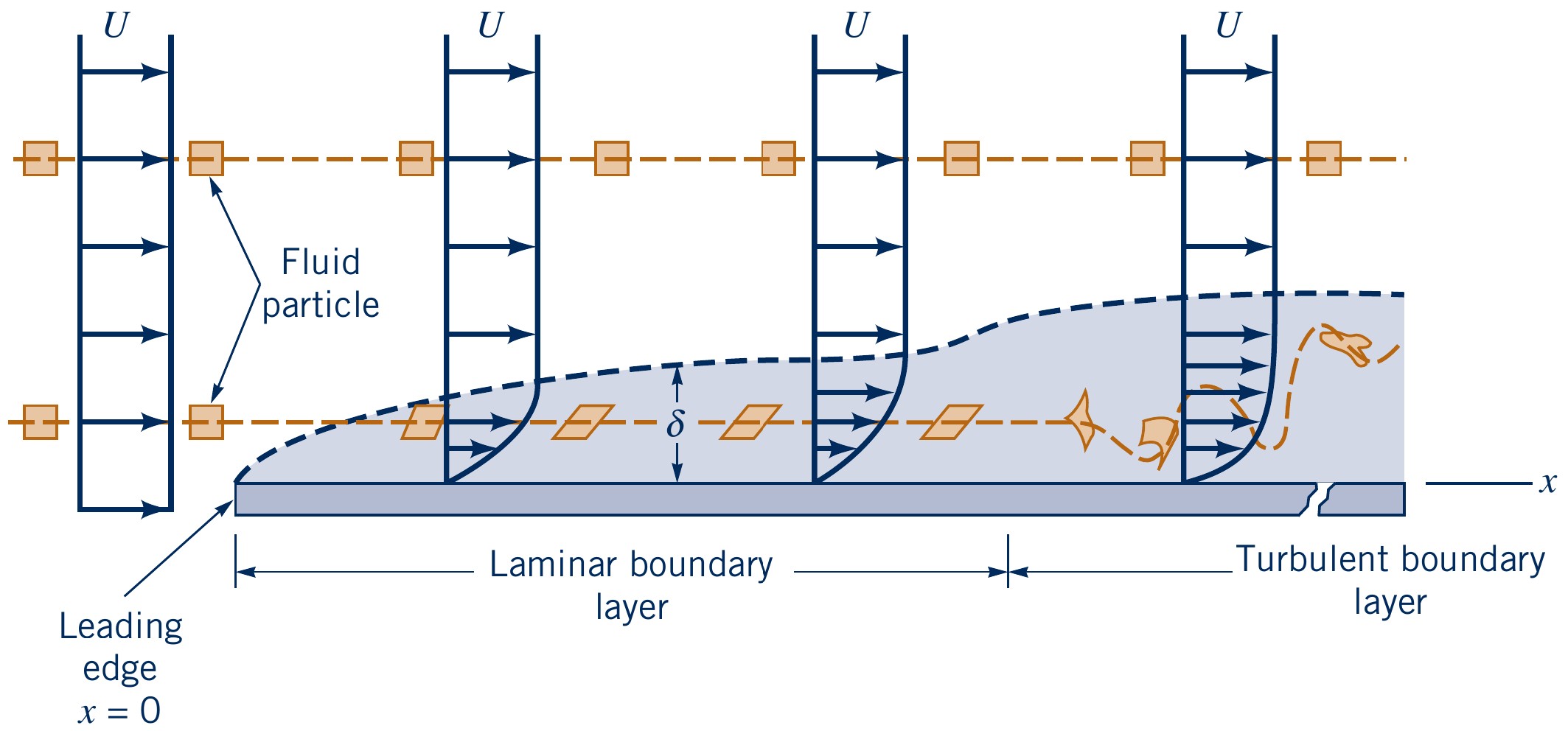
Boundary layer (BL) structure and development for parallel flow over an infinite flat plate
- Only fluid in BL "feels" the plate
- $\text{Re}_x = \rho U x / \mu$ (bulk flow definition)
Laminar BL: Analytical expressions from Blasius BL solution
Turbulent BL: Mostly empirical expressions
Boundary Layer Thickness
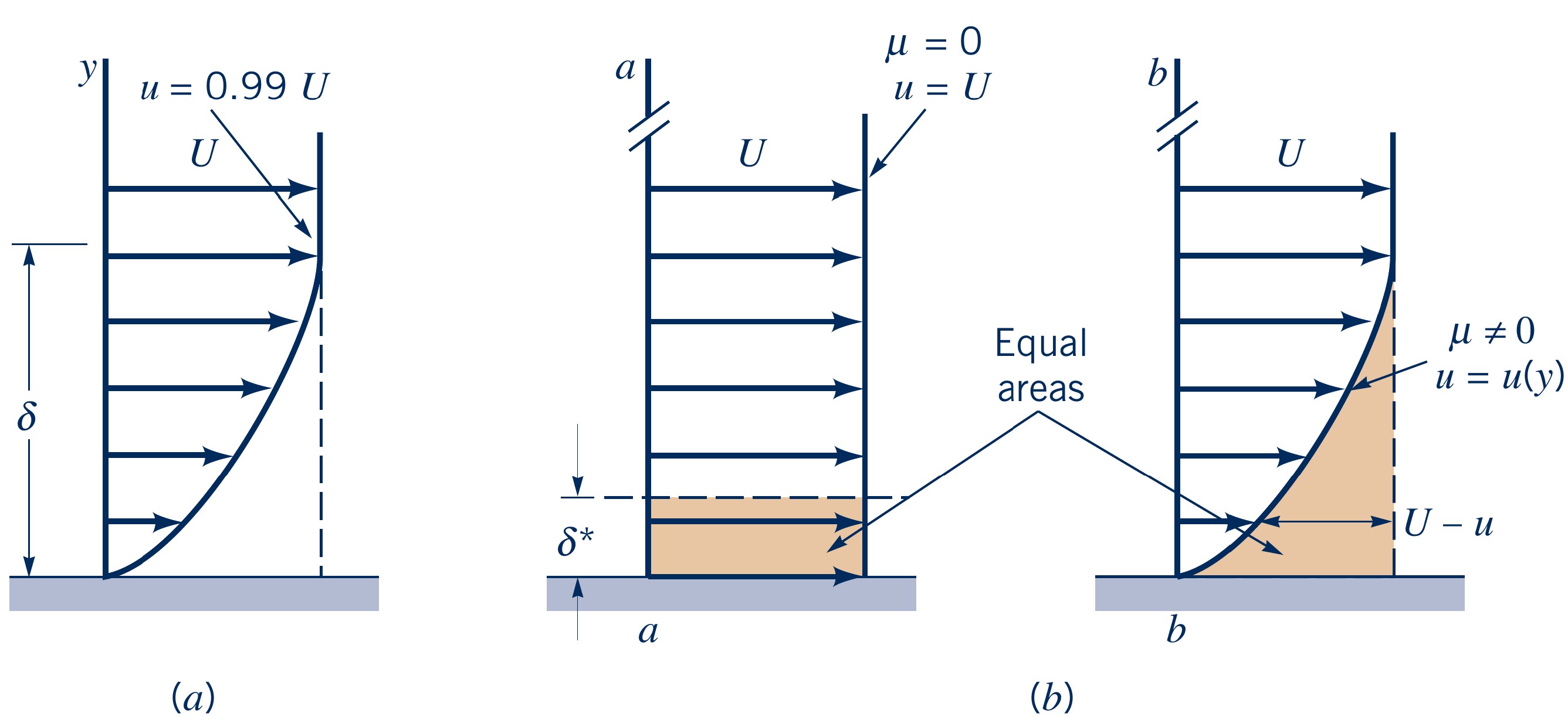
BL thickness definitions:
- Standard BL thickness $\delta_{99}=\delta$
- BL displacement thickness $\delta^*$
- BL momentum thickness $\Theta$
Parallel flow to an (almost) infinite flat plate
Excellent experiment showing turbulent BL triggered by trip wire in this classical flow case
- Note: Friction Reynolds number $\text{Re}_\tau=\frac{\rho \ \sqrt{\tau_w/\rho} \ \delta }{\mu}$ (local) rather than bulk Reynolds number $\text{Re}_x=\frac{\rho \ U \ x}{\mu}$ is used in video
Turbulent Shear Stress
Recall how the instantaneous (horizontal) velocity $u$ could be decomposed into a time-averaged and fluctuating part (Reynolds decomposition):
$$u(x,y,z,t) = \overline{u}(x,y,z) + u'(x,y,z,t)$$
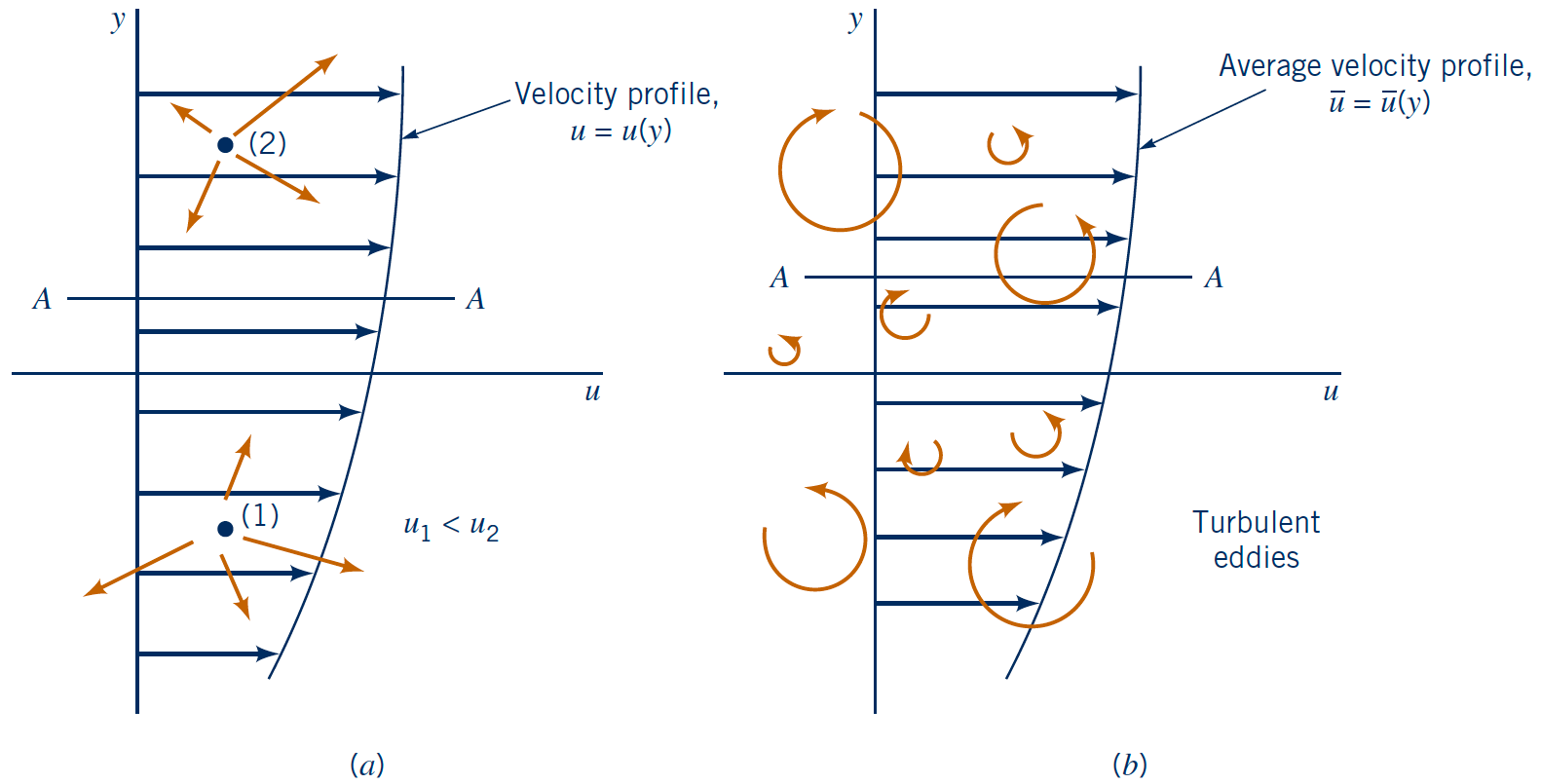
- Tempting to apply our Newtonian shear stress definition directly to $\overline{u}$ in turbulent BL
- However, $\tau \neq \mu \frac{d\overline{u}}{dy}$ (with turbulence)
Let us review the underlying physics:
- Laminar BL
- Molecular diffusion
- $x$-momentum transfer in $y$ due to $\frac{du}{dy} \neq 0$ → Shear stress
- Turbulent BL
- Finite size 3-D eddies
- Increasing momentum transfer
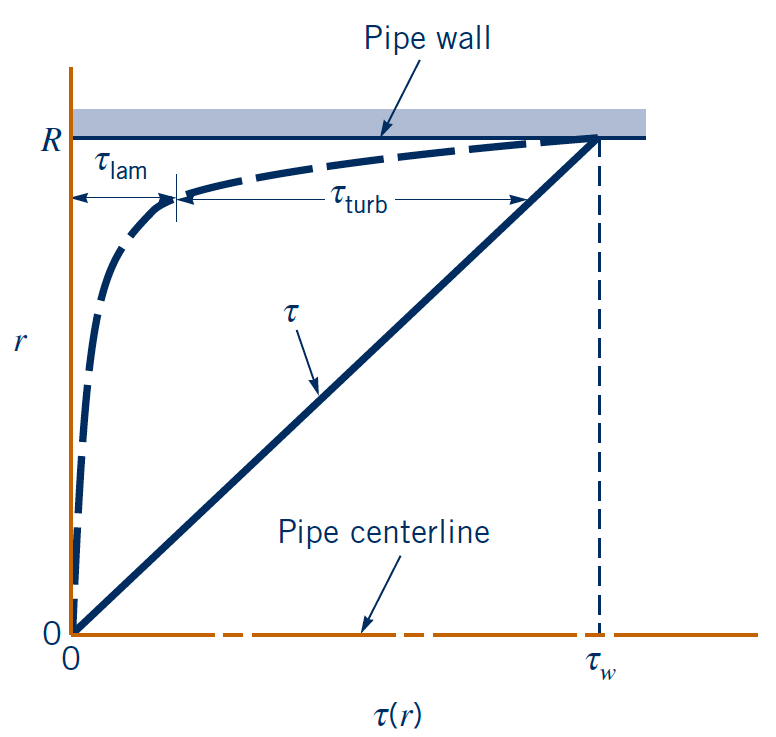
- Extra term in shear stress: $$\tau = \mu \frac{d\overline{u}}{dy} - \rho \overline{u'v'} = \tau_{lam} + \tau_{turb}$$
Reynolds Stresses
The additional contribution to shear stress from fluctuations $\tau_{turb} = -\rho \overline{u'v'}$ has units of Pa and is termed Reynolds stresses.
- These stresses are flow dependent and difficult to describe
- Fluctuating velocities influence the mean flow
- Boussinesq hypothesis: $$\tau = \mu_t \frac{d\overline{u}}{dy}$$
- Shifts the problem from Reynolds stresses to $\mu_t$ (flow dependent scalar)
- The basis of widely used RANS and URANS turbulence models
- Typical ratio of $\tau_{lam}$ and $\tau_{turb}$ in turbulent BL varies with distance to the wall (here for a pipe flow)
Turbulent Velocity Profile
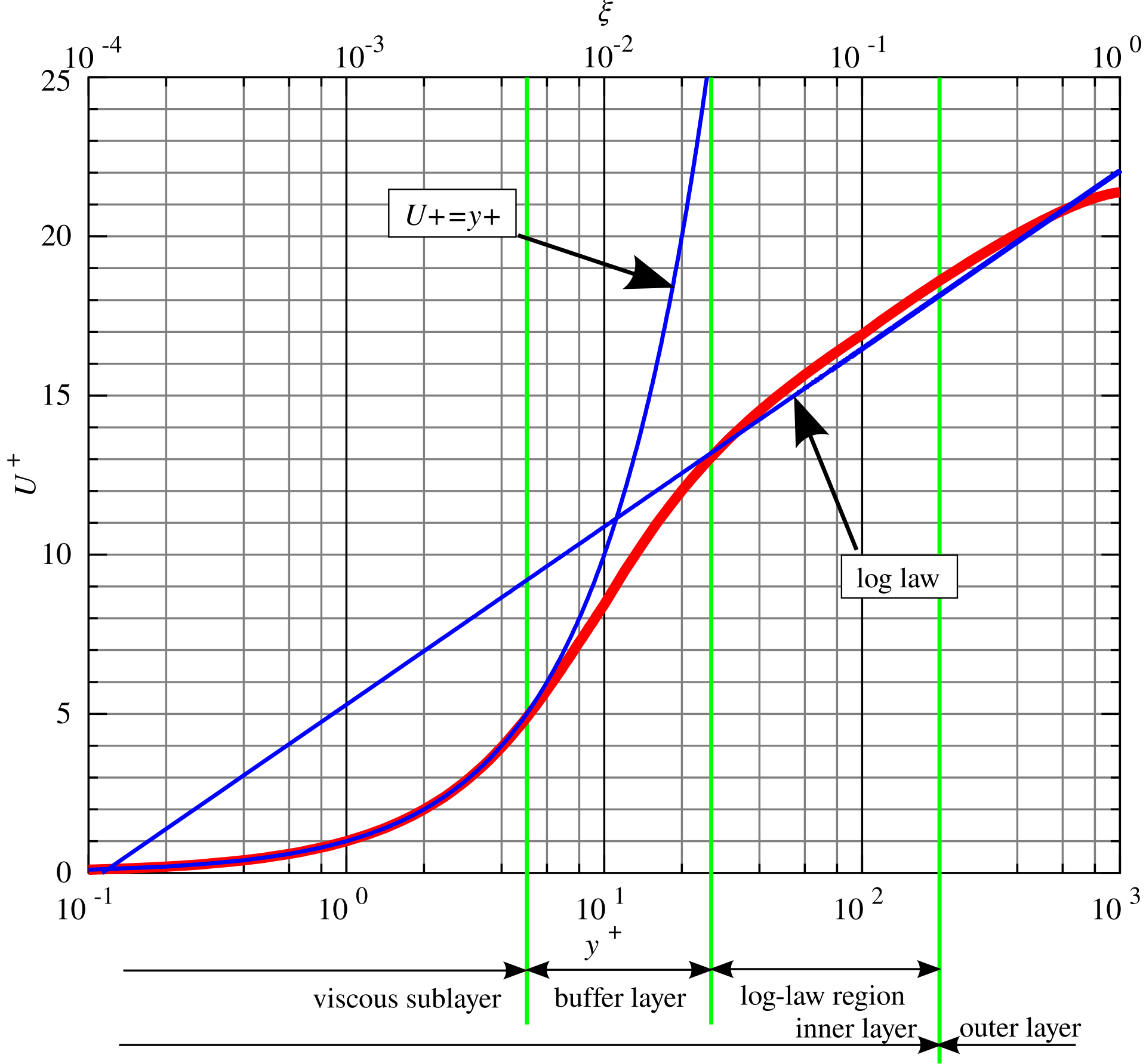
- Dimensionless $y$ coordinate: $y^+ = y u^* / \nu$ with $u^* = \sqrt{\tau_w / \rho}$
- Dimensionless velocity: $u^+ = \overline{u} / u^*$
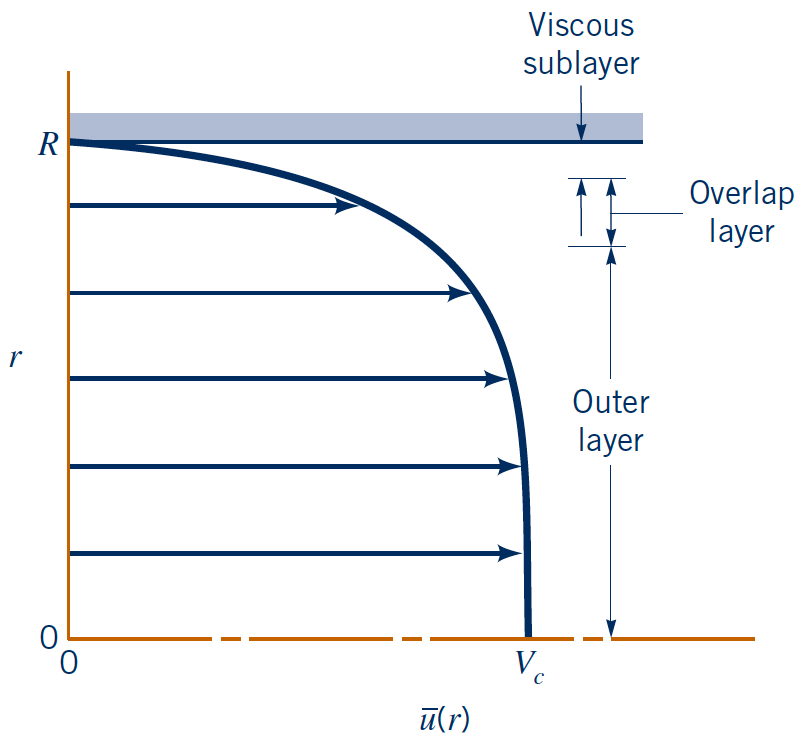
- Viscous sublayer ($y^+ < 5$)
- Viscous forces dominant over Reynolds stresses
- Smooth wall: $u^+ = y^+$
- Buffer layer ($5 < y^+ < 30$)
- Both viscous sublayer and log law important (transition function)
- Log-law layer ($30 < y^+ < 200$)
- Velocity varies as the logarithm of $y$
- Experimentally determined (law of the wall): $$u^+ = \frac{1}{\kappa} \ln(y^+) + C^+$$
- Where $\kappa$ is the von Kármán Constant: $\kappa=0.41$ and $C^+ = 5$ (for smooth walls and flow over infinite flat plate)
- Viscous sublayer extremely thin
- Roughness of the wall can enter viscous sublayer $\rightarrow$ changed $u(y)$